
Description
Product Overview
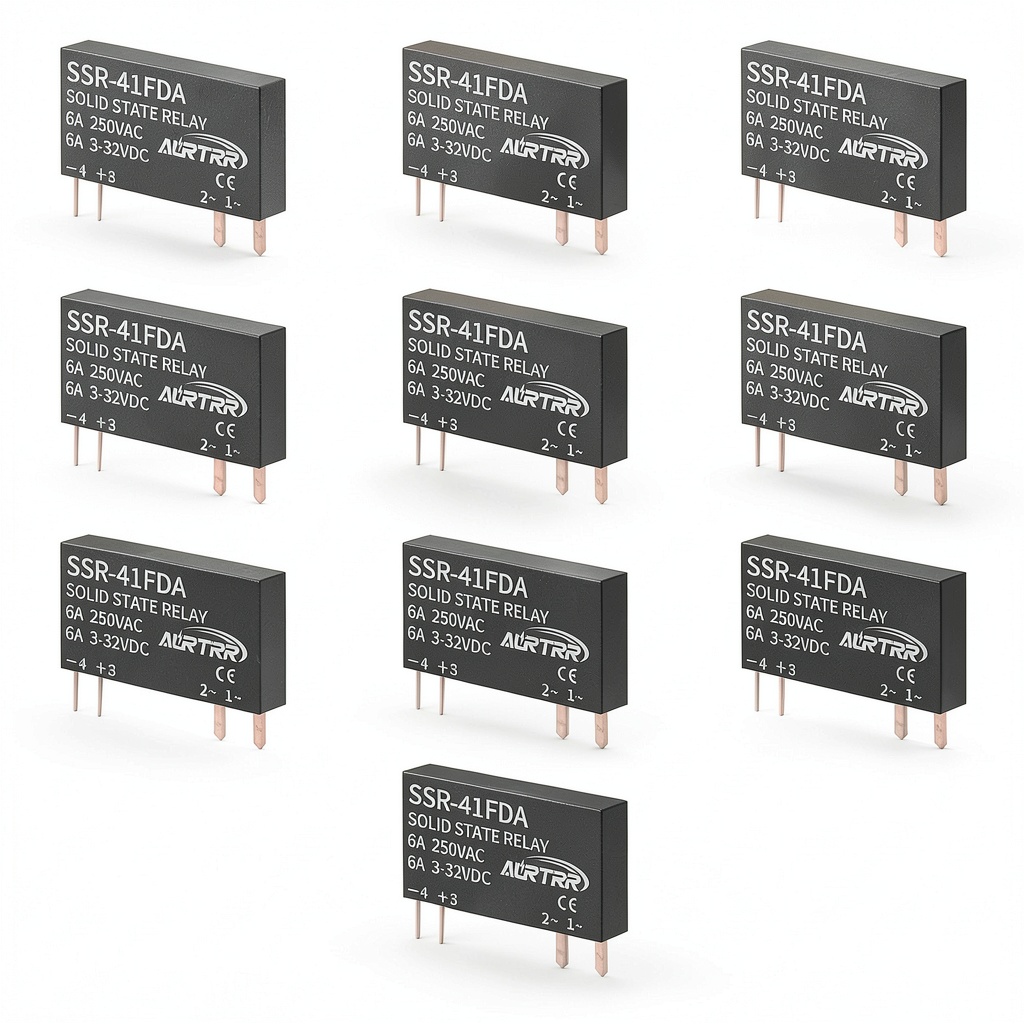
The aurtrr 12V 5V 3V 3.3V solid state relay (SSR) is engineered for developers and engineers who need a reliable, compact switching solution for low‑power AC loads. Measuring just 0.59 x 0.16 x 1.06 inches and weighing only 1.13 ounces, this mini‑size SSR packs a powerful feature set: an input voltage range of 3‑32 VDC, an output voltage range of 24‑250 VAC, and a maximum load current of 0.8 A without a heatsink. Its optocoupler isolation provides complete electrical separation between control and load circuits, eliminating mechanical wear and extending lifespan indefinitely. The device’s fast response time and zero‑noise operation make it ideal for precise timing applications, while its slim profile allows easy integration onto crowded development boards such as ESP32, Raspberry Pi, Arduino, and other microcontroller platforms.
Usage
Designed with hobbyists, makers, and professional engineers in mind, this SSR excels in a variety of environments. Use it to control lighting, small heaters, fans, or any AC appliance that operates within the 0.8 A current limit. Its wide input range means it can be driven directly from the 3.3 V or 5 V logic pins of popular development boards, eliminating the need for additional driver circuitry. The relay’s contactless operation ensures silent switching, which is especially valuable in audio‑sensitive projects or medical equipment prototypes. Whether you are building a smart home automation system, a laboratory test rig, or an IoT device that requires reliable AC load control, the aurtrr SSR delivers consistent performance with minimal heat generation.
Why Choose Us
Choosing the aurtrr solid state relay means selecting a product backed by rigorous quality assurance and a reputation for durability. Each unit undergoes comprehensive testing for input tolerance, output stability, and isolation integrity, ensuring that you receive a component that meets or exceeds industry standards. The relay’s optocoupler design eliminates mechanical wear, providing an effectively infinite lifespan compared to traditional electromechanical relays. Additionally, aurtrr offers responsive technical support and a clear warranty policy, giving you confidence that any questions or issues will be addressed promptly. Our commitment to transparent specifications and reliable performance makes this SSR a trusted component for both prototype development and production‑grade deployments.
Key Features
- Compact mini size fits tight spaces on development boards and PCBs
- Contactless optocoupler isolation provides safe, noise‑free switching
- Wide input voltage (3‑32 VDC) allows direct drive from 3.3 V or 5 V logic
- Supports 24‑250 VAC output up to 0.8 A without additional heatsink
- Responsive customer support and clear warranty for peace of mind
FAQ
Can this relay be used with a 12 V DC control signal?
Yes. The input voltage range of 3‑32 VDC covers 12 V DC, so you can connect the control signal directly from a 12 V source or a microcontroller pin that outputs 12 V.
Do I need a heatsink for the relay?
The relay can handle up to 0.8 A without a heatsink. If you plan to operate near the maximum current continuously, adding a small heatsink will improve thermal performance and extend component life.
Is the relay suitable for switching inductive loads such as small motors?
While the SSR can switch inductive loads within its current rating, it is recommended to add a snubber circuit or flyback diode to protect against voltage spikes and ensure reliable operation.
What is the typical response time of this solid state relay?
The optocoupler design provides a response time in the range of a few microseconds, making it fast enough for most timing‑critical applications.
How does the isolation protect my microcontroller?
The internal optocoupler creates a physical barrier between the control side (low voltage) and the load side (high voltage), preventing any high‑voltage transients from reaching the microcontroller and ensuring safe operation.
Reviews
There are no reviews yet.